
OpenPGP ID, in a nutshell
OpenPGP ID is a digital identity that is:
- universal — characterises all persons of the solar system: physical (humans), legal (organisations), even digital (AI agents);
- decentralised — no central authority, no third-party identity provider, no cloud vault to trust ;
- respectful — built on the strongest encryption primitives we have, so as to protect your privacy as fully as possible;
- interoperable — usable anywhere OpenPGP is accepted (email signing and encryption, document signing, SSH authentication, supply-chain traceability, git, …);
- sovereign — your private keys are yours, on a physical key (YubiKey / NitroKey) you hold in your hand;
- long-lived — your
u4oru5identifier is stable for life; the certificates that back it can be rotated (post-quantum migration, etc.) without changing who you are.
Since January 2026 , OpenPGP ID is in production, shipped in the Djibian GNU/Linux operating system.
What is a sovereign digital identity good for?
In practice, your OpenPGP ID lets you:
- Authenticate without passwords on online services — including on any remote Djibian machine , without ever placing a private key on it.
- Sign your documents, emails, commits, contracts — non-repudiable proof of origin.
- Encrypt your exchanges and personal data, i.e. keep them private.
- Certify the people close to you and weave your web of trust .
- Stop being subjected to identity theft, informational pollution , or generative-AI misuse.
And more broadly, a step toward abolishing certain privileges , and gaining more freedom, equality, fraternity. ✊🕊️💕
Giving birth to your OpenPGP ID
On a Djibian system, the Djibian Onboarding graphical frontend (developed by Sébastien Picardeau ) guides the creation of an OpenPGP identity in about a dozen clicks:
- Launch Djibian Onboarding (menu Applications → Accessories).
- Choose « Configure your OpenPGP security key ».
- Insert your YubiKey or NitroKey — it is detected automatically.
- First time? « Create my OpenPGP identity ».
- Fill in birth name, given names, date of birth, country of birth, email.
- Verify the information.
- Print the QR codes (at least three sheets — see below).
- Scan the QR codes — the key is etched into your YubiKey/NitroKey.
- Done: your OpenPGP ID is born.
Everything offline, no third-party server call. Video demo in the release article .
Backup: paper QR codes, secret sharing
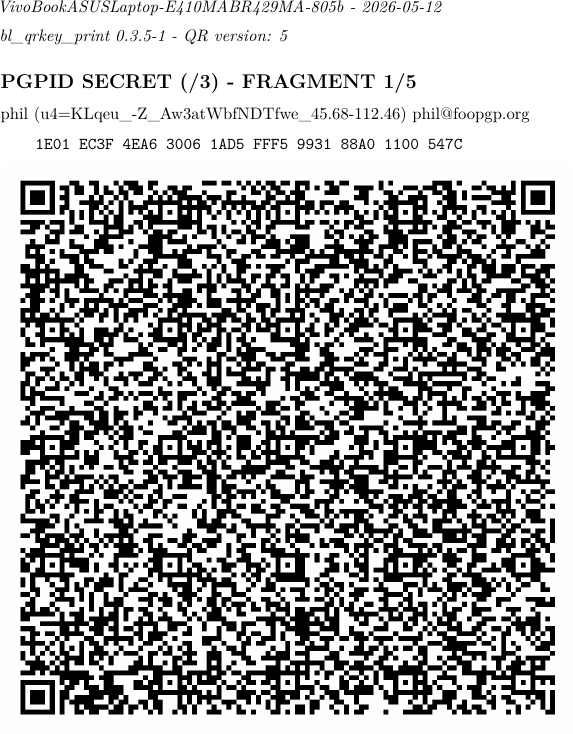
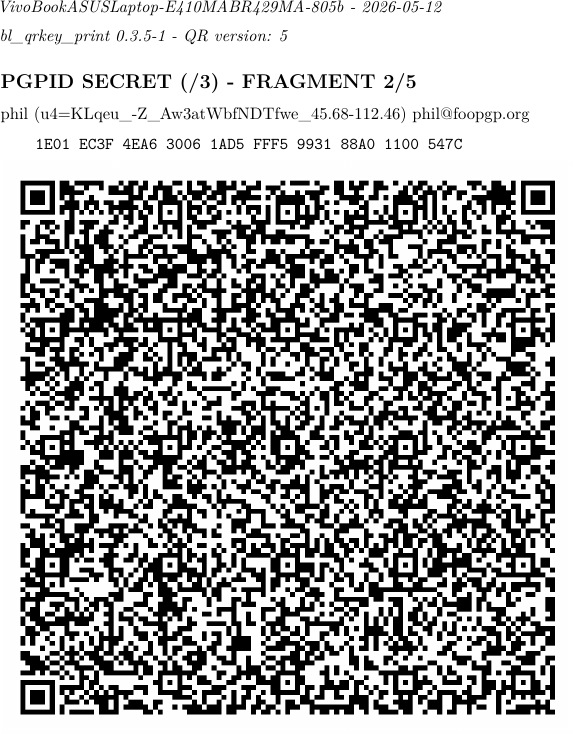
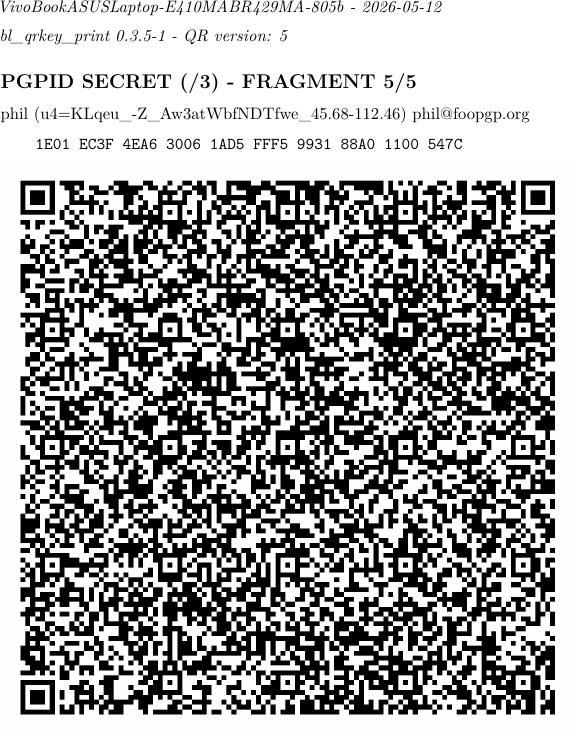
The foopgp tools generate and print your private keys as paper fragments, encrypted and split using a secret sharing (Shamir) scheme: by default, 3 fragments out of 5 printed are enough to reconstitute the key.
 |
 |
 |
|---|---|---|
| Fragment 1/5 | Fragment 2/5 | Fragment 5/5 |
A few properties to know:
- No isolated fragment reveals anything — you need the quorum (3 here) to reconstitute.
- Offline by construction: fragments live on paper only, never on a cloud, never on a connected disk.
- Resilience: losing one or two fragments is not fatal; losing your YubiKey is not either, as long as you have your quorum of fragments.
- Entrusting fragments to people you trust is a common strategy: one fragment with a relative, one with a friend, one in a safe — and impersonation becomes very hard.
Transposing to a physical key
Once your private keys have been fragmented onto paper sheets, another foopgp tool reads the QR codes via a webcam or scanner and etches the keys into a YubiKey or a NitroKey. The private keys never touch a hard drive nor a third-party service.
From there, your identity is exercised from your hand on any OpenPGP-compatible service: sign , decrypt , authenticate — the OpenPGP ID physical key protects your privacy and your human singularity in the digital world.
In short
OpenPGP ID makes real digital sovereignty possible: no password to forget, no cloud vault to trust, no dependence on an external identity provider. An identity that is yours, anchored in a physical object you carry, and usable everywhere.
While others sell you technologies that enslave you, foopgp enables everyone to embrace technologies that serve us. Safer, leaner, and entirely sovereign.