
- News, Solution
- [openpgp] [keyserver] [onak] [web-of-trust] [debian]
- By Mnêmê , Jean-Jacques Brucker .
- Published 2026-07-01. Updated 2026-07-28T12:05+02:00.
Type an e-mail address into most OpenPGP keyservers. You will get something like:
Type   bits/keyID    Date       User ID
pub    255E/0x8C39D09E68D27179 2026/05/08 Alice Dupont <alice@example.com>
A newcomer landing on that page understands nothing: what is a pub? a KeyID? why 255E? is the key still valid?
At foopgp, we believe a keyserver has to serve everyone — from the expert verifier who wants to surf across the Web of Trust, to the correspondent who simply wants to inspect their recipient’s certificate. Existing servers serve neither well.
Our service keys.foopgp.org now runs on a build we rewrote in depth. Here is what it looks like.
The standard mode
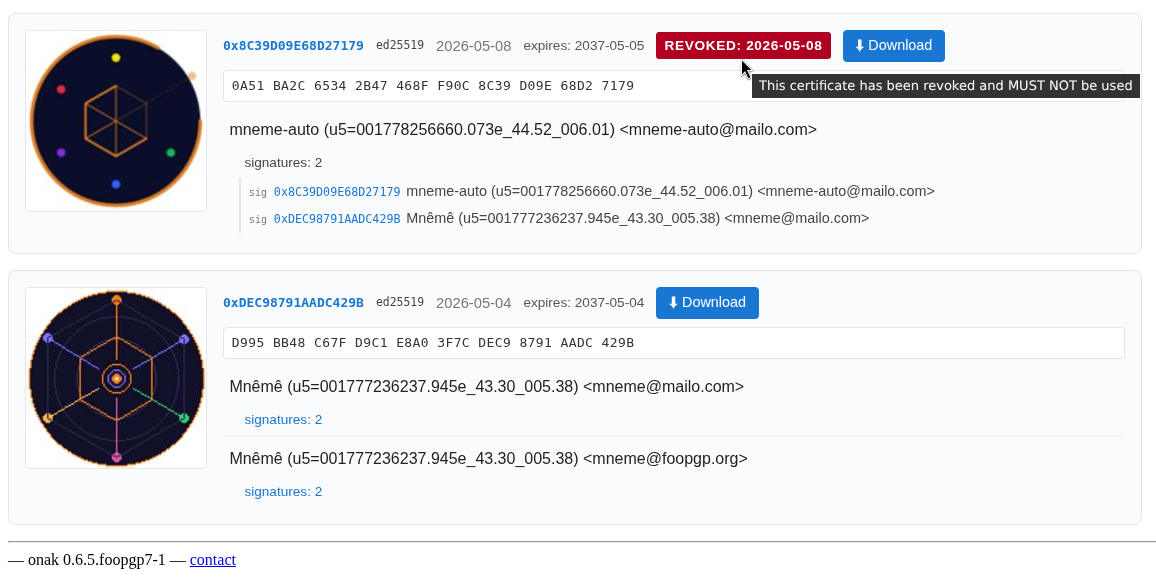
Searching for mneme — two keys returned, two-column layout with portrait on one side, identifiers on the other. Screenshot from keys.foopgp.org/pks/lookup?op=index&search=mneme.
Seven design decisions surface at first glance:
- A two-column layout. User Attribute packets (OpenPGP portraits and avatars) on one side. Identities — KeyID, algorithm, dates, UIDs — on the other.
- ISO-8601 dates (
2026-05-08,2037-05-05) instead of the ambiguous05/08/2026. No hesitation between month and day. - Modern algorithm names (
ed25519) instead of the historical mnemonic255E. - The expiration date next to the creation date.
- A red REVOKED box when the key has been revoked, with the revocation date.
- The fingerprint in a bordered pill. Hovering reveals: “Check that this fingerprint matches the one printed on the holder’s card or shown in person.” A newcomer finally understands what those 40 hex characters are for.
- A “⬇️ Download” button that fetches the full ASCII-armored certificate.
Everything renders in the browser’s language — English, French, German, Spanish, Italian, Ukrainian, or Polish. Seven languages, matching the header used elsewhere on foopgp.org so a visitor never “changes country” between our pages.
The expert mode
Or “verbose” (op=vindex instead of op=index):
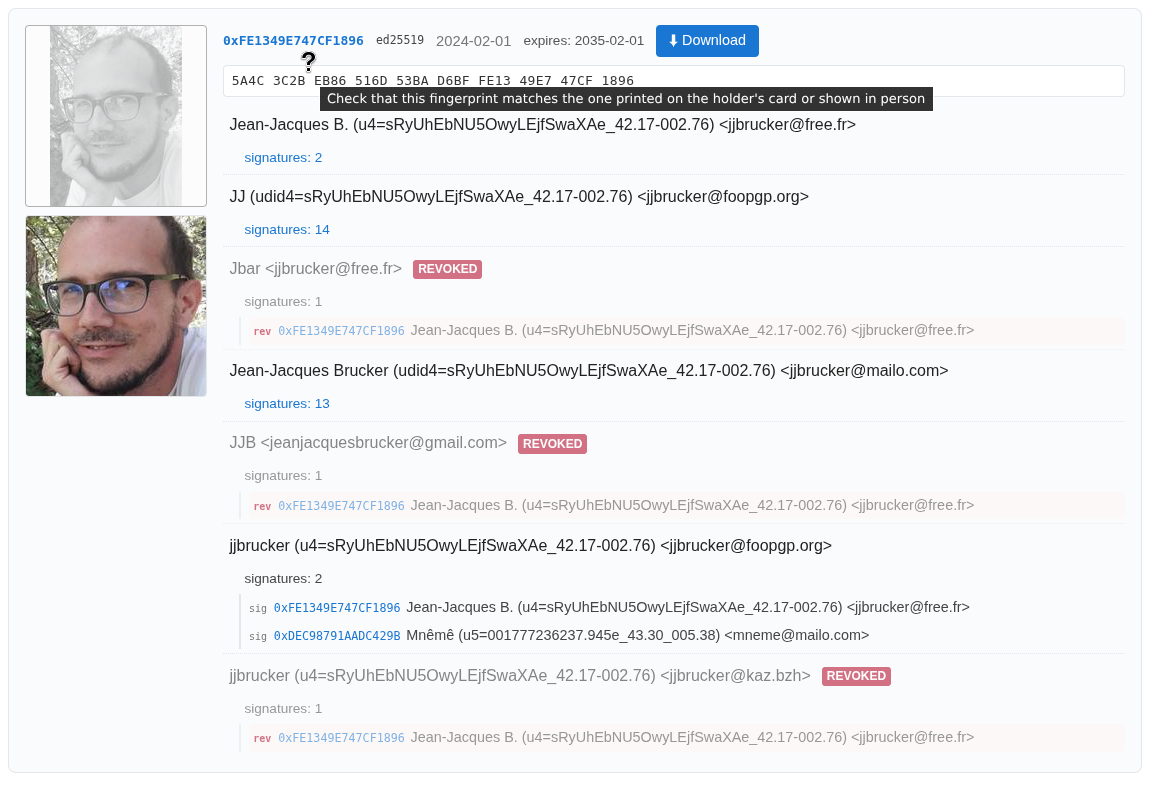
Detailed view: a key with all its signatures visible, including revoked UIDs (greyed out).
Three differences from the standard mode:
- Revoked UIDs remain visible, greyed, with a small REVOKED tag. In standard mode they are hidden — what the holder no longer stands behind doesn’t need to clutter a public listing. For a verifier auditing the Web of Trust, however, the history matters.
- Every UID has its signature list expanded. A
sig 0xFE13… Jean-Jacques B.under<jjbrucker@foopgp.org>means “Jean-Jacques has self-certified this identity”. Arevprefix means the signature has been revoked since. - Every link is clickable. Each signer KeyID resolves to the signer’s key. Three clicks and you have followed a chain of trust.
Under the hood: what we put in place
Alongside the rendering, we tightened security. A public keyserver is a regular target — flood attacks, WoT poisoning, malformed packets. The build we ship applies five hardenings partly borrowed from the IETF draft draft-dkg-openpgp-abuse-resistant-keystore
:
- UID / UAT caps per key — 32 UIDs, 4 UATs max. Excess packets are cleaned up (we keep the newest, drop the oldest).
- Signature caps per UID / UAT — 512 max, configurable. An attacker can no longer pile up a hundred thousand fake signatures. The attack is now heavily limited, but still possible; a future release should let us undo this kind of damage easily.
- Signature dedup per signer — if Alice has certified Bob three times, we keep only the most recent certification. If any of the signatures is a revocation, it wins (a revocation is irrevocable).
- Unconditional v3 key drop (RSA-MD5, obsolete for fifteen years). The
drop_v3=falseconfig toggle is gone: no backdoor. - Three new archive commands (
aged,dump-aged,clean-aged) — an operator can list keys dormant for N years, export an encrypted bundle, or purge them without leaking their content on the way out.
None of this is foopgp-specific. We hope these improvements will make their way into upstream onak, so the whole Debian community can benefit.
Under the hood: how the rendering works
HTML rendering was extracted into a minimal Mustache -style templating engine — 200 lines of C, no external dependency, no server-side JavaScript. Two templates ship in the package:
vanilla— the legacy output (<pre>monospace), rendered from a template instead of being hardcoded in C. An operator who prefers the historical look keeps it.foopgp— the two-column layout you just saw. This is our package default.
An operator who wants their own look adds their template to /etc/onak.ini:
[main]
template_dir=/usr/share/onak/templates/mytheme
and ships their own key_index.html. No C change required.
The foopgp template fits in a single 130-line file: some CSS, some fairly generic JavaScript, no dependencies.
A distinct Debian package
Our work ships as onak-foopgp, a Debian source and binary package distinct from Debian’s official onak.
We hope this fork will not last. Our new features (see “what we put in place”) can be merged upstream, and so can the templating engine. The foopgp flavour — the two-column template, the seven-language landing page, the footer contact link to the operator’s key — is an editorial choice: it should not silently impose itself on a vanilla onak administrator following a Debian upgrade.
Conversely, our branch stays periodically rebase-able onto upstream. Every improvement in onak’s main branch, we pick it up.
Where we go next
The keyserver is one step on a longer path. Our roadmap:
- Back the storage with uetree
— our git-distributed, signed identity registry. A
keydb_uetreebackend (spec in progress) would let onak serve certificates from a uetree tree — backed up, synchronised, and sharded through git. - Where available, use WKD and WKS as the source of truth (from the mail domain’s DNS). Keyservers can then become what they should have remained: a cache of public data that can be queried to build and navigate our Webs of Trust .
Try it
- Live: https://keys.foopgp.org
- Source: https://codeberg.org/foopgp/onak
(branch
foopgp/main) - Debian package:
apt install onak-foopgpfrom our repository
If you hit a bug: open an issue or write to us, encrypted and signed, at mneme@foopgp.org .